Tucson’s water is hard, which means it carries a lot of dissolved calcium and magnesium. As pool water evaporates in our heat, those minerals stay behind, so calcium builds up, pH and alkalinity tend to drift up, and white scale forms on tile, finishes and salt cells. The fix is steady testing, keeping pH in range, and a partial drain and refill when minerals get too high to manage.
Here is what is going on in your pool and what you can do about it.
Why is Tucson water so hard on pools?
According to Tucson Water, the area’s groundwater is naturally hard, and hardness increases as more Central Arizona Project (Colorado River) water is blended in. Hard water is safe to drink, but it matters for pools. The city suggests using a pool test kit to find the hardness of your own water.
Two things stack up in a Tucson pool:
- Your fill water already contains minerals. Every top-off adds more calcium.
- Evaporation removes water, not minerals. Hot sun, low humidity and wind pull a lot of water out of the pool. The calcium stays, so the concentration creeps up over time.
That is why a pool that was balanced at startup can drift out of balance over a year or two, even if you never add calcium.
If you are not on Tucson Water, the same idea applies. Marana, Oro Valley and other providers have their own water sources, so test your tap water to know your starting point.
What is calcium hardness, and why does it matter?
Calcium hardness is the amount of dissolved calcium in your pool water. Some calcium is good. Water with too little calcium can pull it out of plaster and grout. But in Tucson, the usual problem is too much.
When calcium is high and the water is out of balance, calcium comes out of the water and sticks to surfaces. That is scale. Water balance depends on several readings working together:
- pH
- Total alkalinity
- Calcium hardness
- Water temperature
- Total dissolved solids
Pool pros often combine these into one number called the saturation index. You do not need to calculate it yourself, but the idea is useful: when pH, alkalinity, calcium and temperature are all high at the same time, scale forms fast. A hot Tucson summer pushes temperature up, so the other readings need to stay in check.
Why does white scale form on pool tile?
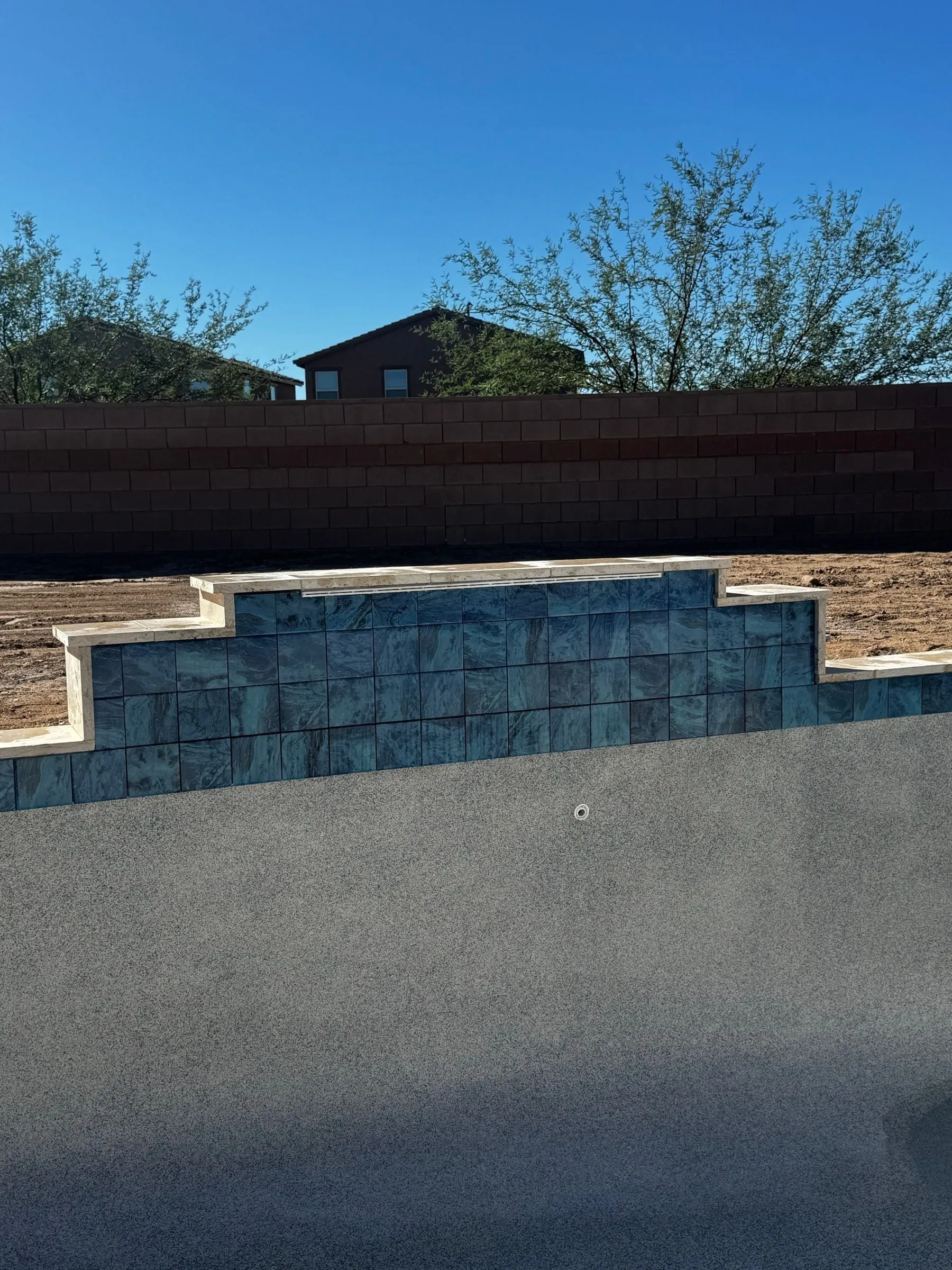
The white or gray crust at the waterline is the most common hard-water complaint we hear. It forms where water evaporates and splashes on the tile, leaving minerals behind. Water features, sheer descents and spillways can build scale fast because they spread water thin across hot surfaces.
How to slow it down
- Keep pH from creeping up. High pH is the biggest driver of scale.
- Wipe the tile line with a soft brush or sponge during regular cleaning, before deposits harden.
- Keep the water level steady. An automatic fill or regular top-offs prevent a wide band of exposed, drying tile.
- Use a cover. It cuts evaporation, which means less mineral buildup over time. See our post on pool covers in Arizona.
How to remove light scale
Light scale can often be removed with a scale remover made for pool tile, used exactly as the label says. Be careful with abrasive tools. Pumice stones can scratch glass tile and some glazed tiles, so check what tile you have first. Heavy, hardened scale is a job for a tile cleaning specialist.
If your tile is damaged or badly etched, new tile may be the better answer. We replace tile and coping as part of pool tile and coping projects.
Why does pool pH keep rising in Arizona?
Many Tucson owners find themselves adding acid often. A few reasons:
- Aeration. Waterfalls, spillways, deck jets and bubblers stir the water and push pH up.
- Salt chlorine generators tend to raise pH as they make chlorine.
- New plaster raises pH for a while as it cures.
- High alkalinity acts like a spring, pulling pH back up after you lower it.
The CDC’s guidance for home pools recommends keeping pH between 7.0 and 7.8. That range balances germ killing, swimmer comfort and the life of your equipment. In hard water, staying in the lower part of your target range helps keep scale down. Follow the label on any acid product, add it slowly with the pump running, and retest before adding more.
What does stabilizer (CYA) do in strong sun?
Sunlight breaks down chlorine. Tucson gets a lot of strong sun, so an unprotected pool can lose its chlorine fast. Cyanuric acid, also called CYA or stabilizer, shields chlorine from the sun.
The trade-off is that stabilizer also slows chlorine down. The CDC notes that germs take longer to kill when cyanuric acid is present, and it recommends at least 2 parts per million of free chlorine in pools that use stabilizer, compared with at least 1 ppm in pools without it.
A few things to know:
- Stabilizer builds up. Chlorine tablets and some granular chlorine add CYA every time you use them. It does not evaporate, so it keeps climbing.
- Too much makes chlorine weak. Very high CYA can leave you fighting cloudy water or algae even with chlorine in the pool.
- Dilution is the main fix. Lowering CYA usually means a partial drain and refill.
- Follow your system’s range. Salt cell makers and test kit makers publish target ranges for CYA. Stay within the range your equipment calls for.
Our post on salt vs chlorine pools in Tucson covers the two main ways to sanitize.
Why do salt cells scale up in Tucson?
A salt chlorine generator makes chlorine by passing a current through salty water. The process raises pH right at the cell plates, so calcium in hard water likes to deposit there. Over time, white scale coats the plates and the cell makes less chlorine.
To keep a salt cell working well:
- Inspect it regularly. Many cells have a clear housing so you can see the plates.
- Clean only as the manufacturer directs. Most makers describe a mild acid soak and warn against scraping the plates.
- Keep pH and calcium in range. Balanced water is the best prevention.
- Watch the salt reading. A scaled cell can give misleading readings.
Cell cleaning is homeowner maintenance. If the cell or controller has a fault, call the equipment maker or a pool service company.
How often should you test pool water?
| What to test | How often | Why |
|---|---|---|
| Free chlorine and pH | The CDC recommends at least twice a day, more with heavy use | Germ control and comfort |
| Total alkalinity | Weekly or every other week | Keeps pH steady |
| Calcium hardness | Every few weeks, and after big top-offs | Tracks buildup from hard water |
| Stabilizer (CYA) | Monthly, or more if you use tablets | Builds up over time |
| Salt (salt pools) | Per your cell’s instructions | Cell performance |
The CDC says a DPD test kit gives more accurate results than test strips, though both can work. Many pool supply stores also test water for free. Test more after monsoon storms, when rain, dust and debris throw the water off. Our monsoon pool care guide has a full checklist.
When does a partial drain and refill make sense?
When calcium, stabilizer or total dissolved solids get too high, chemicals alone cannot bring them down. Replacing part of the water with fresh water dilutes them.
A partial drain and refill may make sense when:
- Calcium keeps climbing and scale returns soon after cleaning.
- Stabilizer is too high and chlorine is not keeping up.
- The water stays dull or cloudy even with good filtering and balance.
Things to keep in mind in Tucson:
- Test your tap water first. If your fill water is already hard, a partial drain helps less than you might expect.
- Follow local draining rules. The City of Tucson and Pima County have rules on where pool water can go and what chlorine level it must have. Our monsoon guide, linked above, summarizes them.
- Plan for the water cost. See how much it costs to fill a pool in Tucson.
- Avoid fully draining in summer heat. An empty pool exposes the finish to sun and, in some soils, can put stress on the shell. Get expert advice before draining a pool completely.
- Mild weather is better. Cooler months are easier on the finish during a drain and refill. Our winter pool care guide has more seasonal tips.
Can hard water damage a pool finish?
Out-of-balance water can stain, scale or etch a pool finish over time. Scale feels rough. Low pH or very soft water can etch plaster. Pebble finishes like StoneScapes Mini Pebble hold up well, but they still need balanced water.
If your finish is rough, stained or worn through, it may be time for pool resurfacing.
Building or remodeling with Tucson water in mind
Good design makes hard water easier to live with. We plan equipment, tile and water features with our local water in mind, and every build uses Pentair equipment, including Clean & Clear Plus cartridge filters that you rinse instead of backwash. Learn more on our Pentair equipment page.
We do not offer weekly cleaning or repair service, but we are happy to answer questions about building or remodeling a pool. Meraki Pools AZ is a family-owned Tucson pool builder, licensed under AZ ROC #342505 and #352797. Call (520) 342-8335 or request a free estimate.
Put this guide to work
Planning your own project? See our Pool Tile & Coping Replacement in Tucson, or read about building a pool in Marana or Oro Valley.
Frequently asked questions
Why is there white crust on my pool tile in Tucson?
That white line is usually calcium scale. Tucson's water is naturally hard, and as pool water evaporates in our heat, the minerals stay behind and build up at the waterline. High pH and alkalinity make it worse, so keeping the water balanced slows it down.
Is Tucson water hard?
Yes. Tucson Water says the area's groundwater is naturally hard, and that hardness rises as the share of Colorado River water delivered by the Central Arizona Project goes up. The city suggests using a pool test kit to check the hardness of your own water.
How often should I test my pool water in Arizona?
The CDC recommends testing chlorine and pH at least twice a day, and more often when the pool gets heavy use. Calcium hardness, alkalinity and stabilizer change more slowly, so many owners check them every week or two and after topping off a lot of water.
Does a salt pool have more scale problems?
Salt chlorine generator cells can build up calcium scale on their plates, especially in hard water with high pH. Inspect the cell regularly and clean it following the manufacturer's instructions. Keeping pH and calcium in the maker's recommended range slows the buildup.
When should I drain my pool to lower calcium?
When calcium hardness or stabilizer gets too high to manage with normal balancing, a partial drain and refill is often the fix. Because Tucson fill water is also hard, it helps to test your tap water first. Follow your city or county's pool draining rules, and do not fully drain a pool in summer heat without expert advice.